

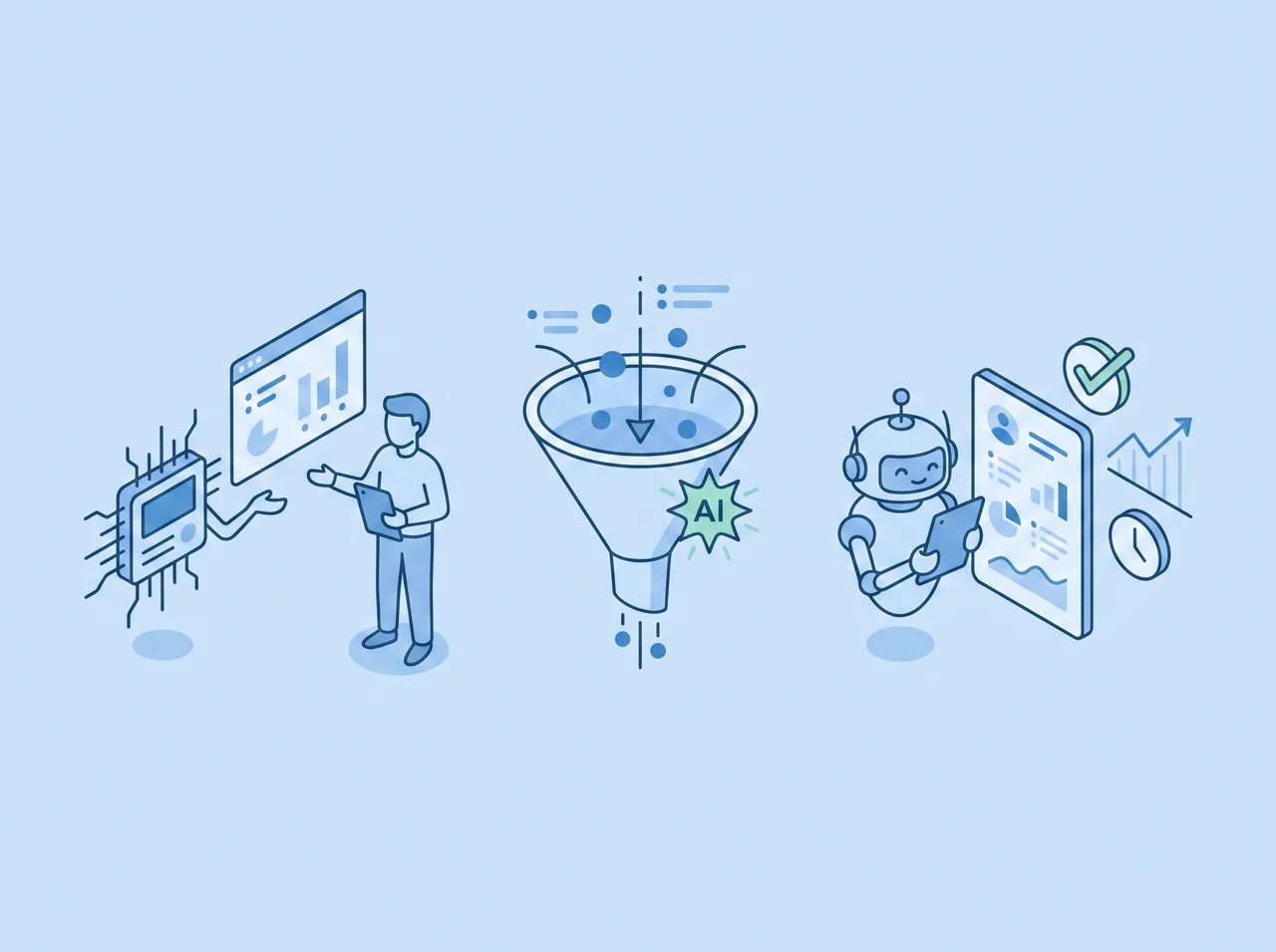



AI is perceived as a threat
Employees wonder whether tasks are being replaced, assessed or more strongly monitored. Without open communication, resistance arises, even when the use case is sensible.
AI projects rarely fail on technology alone. Often orientation, trust, clear roles and understandable rules are missing. Aviando supports mid-sized companies in introducing AI so teams understand the value, act safely and genuinely adopt new ways of working.
A tool can be switched on. A new way of working does not emerge from that alone.
When AI intervenes in processes, questions arise. Which tasks change? Which results may be adopted? Who carries responsibility? What happens to existing roles? Which data is allowed? How is quality safeguarded?
In mid-sized companies these questions are especially visible. Teams work close to the processes, decisions are often made quickly and informal routines have grown over years. AI can take a lot of the load off there, but only if the change is guided deliberately.
Aviando helps you introduce AI not as an isolated project, but as a comprehensible step toward better ways of working.
Many companies start with AI through individual pilots, workshops or tools. That makes sense. But after the first test, it is decided whether real impact emerges from it.
Without change management, AI solutions often get stuck in small groups. Some use them intensively, others not at all. Some overestimate results, others distrust everything. Managers expect efficiency, while teams do not know how to use AI safely.
Good change support creates clarity. It explains why AI is being introduced, what concretely improves, which limits apply and how employees are supported.
Employees wonder whether tasks are being replaced, assessed or more strongly monitored. Without open communication, resistance arises, even when the use case is sensible.
Management sees potential for productivity and efficiency. Teams, however, initially experience additional questions, new tools and uncertainty.
Nobody knows exactly who is responsible for approvals, quality, prompt standards, data access, monitoring or further development.
A first team tests AI successfully. After that, the plan for how insights are shared, standards developed and further areas brought in is missing.
There is an AI policy, but nobody knows how it should be applied in everyday work. As a result, usage stays either cautious or uncontrolled.
We do not consider change only at rollout. Already during strategy, use case selection and pilot design, we clarify which people are affected and which support they need.
Teams accept AI more readily when the concrete benefit becomes visible. That is why we translate use cases into everyday situations: less searching, faster preparation, better quality or less manual rework.
AI needs clear ownership. This includes departments, IT, data protection, leadership, key users and people who review results or develop processes further.
Rules have to become practical. We help prepare guidance on data, quality, human control and tool use so it lands in meetings, tasks and processes.
Change does not work in a linear way. We create feedback loops so users share experiences, problems become visible and solutions can be improved in a targeted way.
Who is affected? Who decides? Who has to be involved early? Which groups have a strong influence on acceptance?
Which messages does the company need? What is explained? When are managers, pilot groups and teams informed?
Who is responsible for use cases, data, quality, approvals, enablement, governance and further development?
How are policies translated into concrete ways of working? Which examples show what is allowed, sensible or critical?
Which signals show whether the change is succeeding? Options include usage, acceptance, time saved, error reduction, quality or feedback from teams.
When AI is used directly in Salesforce, it changes CRM routines. Sales, service or marketing have to understand when an agent supports, which data is relevant and where human review remains necessary.
When tools such as Langdock, Microsoft Copilot or other platforms are introduced, the change often affects many roles at once. Here clear rules, training and examples are especially important.
Individual agents often reach deeper into processes. That is why it takes clear communication, human-in-the-loop logic, responsibilities and monitoring.
Even small automations change work. When tasks are removed, prepared or redistributed, teams should understand how the new workflow functions.
The impact shows in the organisation. After the first weeks it is visible who decides, who supports and how a pilot turns into regular operation.
The more areas are involved, the more important communication, roles and shared rules become.
Concerns about data, quality, control or job changes should be addressed actively.
The step from a small test group into broader use needs structure.
AI champions, product owners, process owners or governance roles have to be introduced in an understandable way.
AI literacy, risk assessment and clear responsibility become more important, especially when AI is used in recurring company processes.
We assess how well your company is prepared for an AI rollout. We look at leadership, teams, tools, data, communication and past experiences.
Together we define who has to be involved and which responsibility individual roles take on.
We develop clear messages for leadership, pilot groups and teams. The goal is orientation instead of uncertainty.
We support teams during the first AI tests, gather feedback and translate insights into next steps.
When a pilot works, we plan the next step. Which teams follow? Which prerequisites are missing? Which standards are adopted?
Trainings, labs, office hours, playbooks and champion formats belong to enablement and live with AI adoption & enablement.
See servicesWhen teams need practical confidence, training, labs and guardrails help.
Learn moreWhen target picture, use cases or roadmap are still unclear, change management should be connected with strategy.
Learn moreWhen an agent reaches deep into existing workflows, the change should be guided deliberately.
Learn moreChris Uhrig, CTO & Co-Founder of Aviando, looks at your organisation, planned AI use cases and possible uncertainties in the team with you. Together you clarify which communication, roles and enablement formats are needed so AI is not only tested but adopted.